

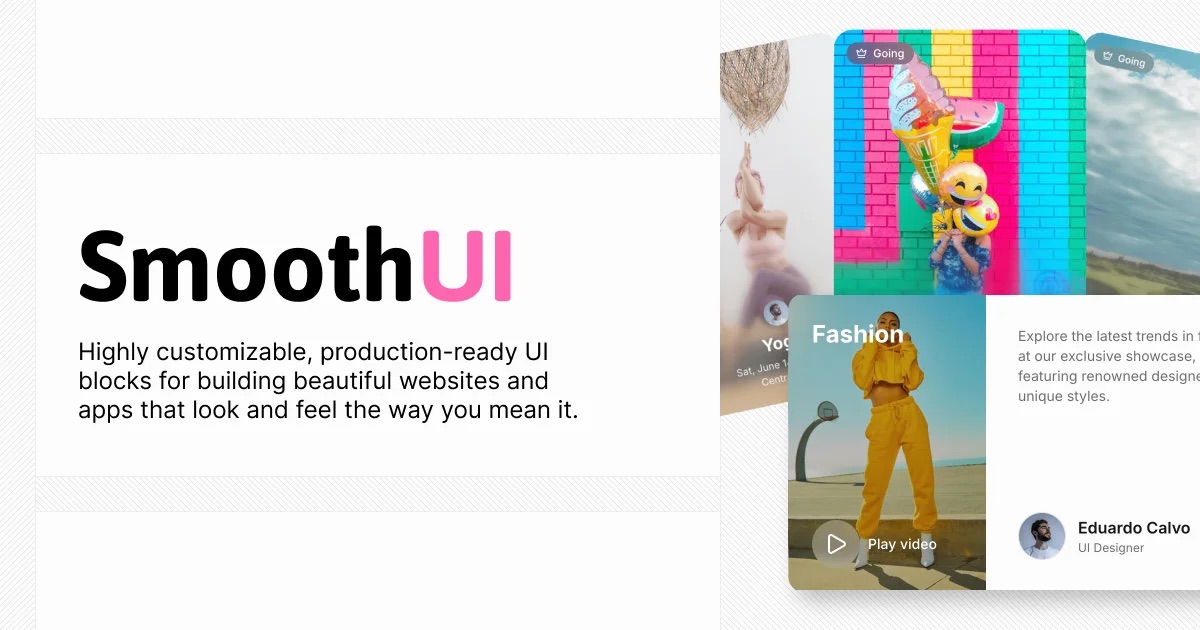
SmoothUI

A collection of awesome test components with smooth animations.

Published on July 3, 2024

Views
100 views
Reading time:
Reading time: 3 min
SmoothUI

##Project Overview

SmoothUI is a web platform dedicated to showcasing a collection of interactive, visually appealing components designed to teach and experiment with web animations. Its main purpose is to make learning animations easier through practical, polished examples, using tools like Framer Motion, CSS, and JavaScript. Built with a friendly and intuitive interface, this project helps designers and developers understand and apply animation concepts in their own projects in a smooth and creative way.

The website's tagline -- "A collection of awesome test components with smooth animations" -- reflects the intention of building a library of test components. These components illustrate advanced animation techniques, with the goal of refining and simplifying their implementation in real-world applications.

##Context and Motivation

The motivation behind SmoothUI stems from the growing need in web development for interactive interfaces that capture user attention through fluid movements and transitions. The platform addresses this demand by providing a tool where advanced animation examples can be visualised and replicated, making it ideal for both beginners and professionals looking to sharpen their skills.

By incorporating Framer Motion as one of the primary animation engines, SmoothUI serves as a solid reference for those looking to explore its capabilities, with a codebase that allows users to view and copy the snippets used in each component. This facilitates learning by providing direct access to the fundamentals of each animation.

##Components and Technologies Used

  1. Framer Motion: SmoothUI uses this powerful React animation engine to create smooth transitions and interactive gestures. Each component is designed to demonstrate a specific animation technique or style, and Framer Motion makes configuration straightforward without sacrificing quality.

  2. CSS: Through CSS, SmoothUI ensures that styles and animations integrate harmoniously, enhancing visual performance and maintaining consistency across different devices.

  3. JavaScript: JavaScript provides the logic for dynamic interactions, allowing each component to respond to user events and changes efficiently.

  4. React: The SmoothUI user interface is built with React, enabling smooth navigation, instant component updates, and an optimised data flow for each animation.

##Challenges and Solutions

  1. Optimising Animations for Mobile and Desktop: One of the biggest challenges was ensuring animations ran smoothly across different screen sizes. To address this, responsive design techniques and adaptive animations were implemented that automatically adjust based on device resolution.

  2. Accessibility: SmoothUI pays special attention to accessibility, ensuring each animation has visual and timing alternatives for users with different abilities. This makes SmoothUI's content more inclusive and accessible to a wider audience.

  3. Code Viewing and Copying: To make learning and implementation in personal projects easier, SmoothUI added a code view and copy feature. This approach lets users access the component structure directly and experiment on their own, encouraging active learning.

  4. Performance and Resource Consumption: Each component was optimised to avoid excessive resource consumption, a critical factor in ensuring fast loading times and smooth performance on hardware-constrained devices.

##Future Expansions

Looking ahead, SmoothUI plans to integrate more components with complex animations and examples inspired by real-world use cases, such as mobile app transitions and form micro-interactions. Additionally, the platform may explore incorporating sound into animations to create even more immersive experiences, further expanding the learning and experimentation potential for its users.

Project link: Smoothui.dev